



By La Velle Goodwin
Collision Prevention Specialist
Founder, Driving Hero Academy
Most serious intersection collisions don’t occur because drivers break the law - they occur because drivers fail
to see or correctly interpret developing threats. Data from U.S. and Canadian studies shows that recognition
errors, misjudgment of gaps, and over-reliance on right-of-way rules dominate collision causation. This article
explains why ordinary drivers are vulnerable at intersections and what strategic driving practices can prevent
collisions.
Key Takeaways
• Roughly one-quarter of U.S. traffic fatalities and about half of all traffic injuries occur at intersections. Source: Federal Highway Administration – Intersection Safety • In the National Motor Vehicle Crash Causation Survey (NMVCCS), roughly 96% of intersection collision events had driver-attributed critical reasons, with recognition errors dominating. Source: NMVCCS – National Academies Press • Recognition errors - failing to see or misinterpreting hazards - are the largest driver-related cause of collisions. • Legal right-of-way is a coordination tool, not a safety guarantee. • Skilled drivers shift focus from “Do I have priority?” to “What could go wrong here right now?”The Trap Most Drivers Fall Into
Most drivers are trained to follow rules and assume that compliance equates to safety. Over time, this leads to predictable vulnerabilities: • Late threat recognition • Narrow or incomplete scanning • Overcommitment to a chosen path of travel • No contingency planning if expectations are violated These drivers are not reckless. They are rule-focused, and rule-focus without threat awareness can blind drivers to developing hazards. Rules organize traffic but cannot substitute for real-time threat assessment.The Data Behind the Problem
According to the Federal Highway Administration, intersections account for roughly one-quarter of traffic fatalities and about half of all injuries. In the NMVCCS crash causation survey, roughly 96% of intersection collision events were driver-attributed, meaning the last failure in the chain was linked to driver behavior - not legal fault or recklessness. Recognition errors - such as inattention, inadequate surveillance, or failing to detect another road user in time - were the largest single category. Canadian collision patterns at intersections show nearly identical trends, reinforcing the global relevance of these findings.Survival Requires a Different Question
Rule-based driving asks: “Do I have the right of way?” Crash-avoidance driving asks: “What could go wrong here right now?” Skilled drivers evaluate: • Time-to-conflict rather than assumed priority • Speed differentials rather than signals alone • Line-of-sight limitations rather than ideal behaviours • Probability of human error rather than expected compliance This is the difference between compliance driving and strategic driving.Why Recognition Errors Kill
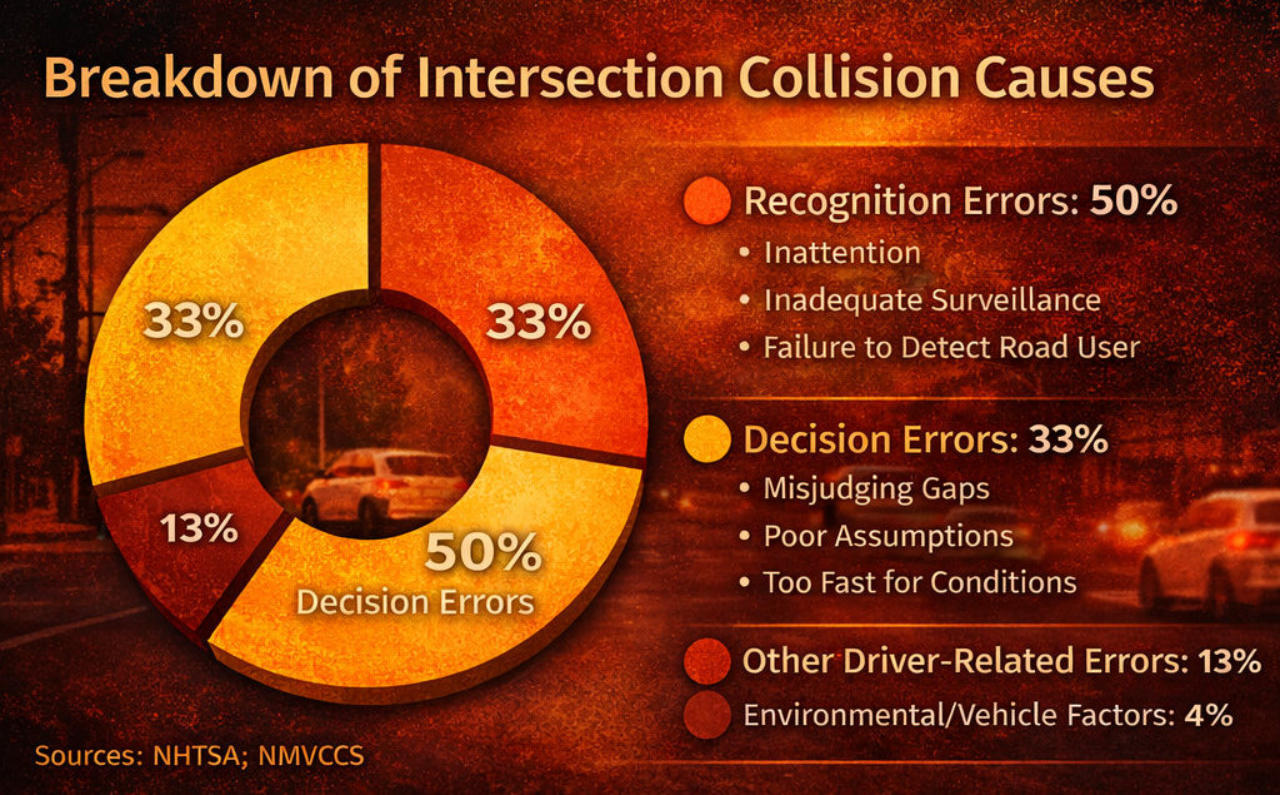
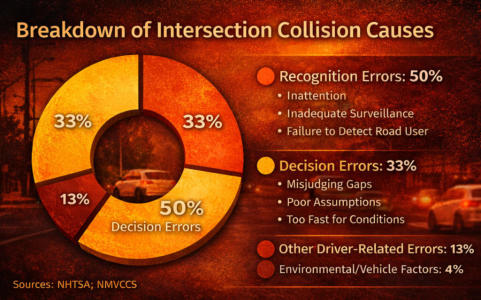
Recognition errors account for roughly four out of ten crashes when categorized conservatively. When related subcategories are combined, recognition failures represent approximately half of all collision events. Decision errors - misjudging gaps, assuming another driver’s intent, or driving too fast for conditions - account for an additional one-third of intersection collisions. Together, this shows that the majority of serious collisions occur because drivers either fail to see the hazard or misjudge it, not because they break rules knowingly.The Older Driver Paradox
NHTSA’s analysis shows older drivers are disproportionately involved in failure-to-yield collisions at stop signs and traffic signals, despite obeying all traffic controls. Common contributing factors: • Inadequate surveillance • Misjudgment of another vehicle’s speed or gap • Turning with an obstructed view These drivers rely on the rule rather than active threat assessment, exposing a systemic vulnerability.How Licensing and Testing Reinforce the Problem
Driver exams reward: • Rule adherence • Procedural correctness • Visible compliance They don’t test: • Early threat detection • Predictive scanning patterns • Risk calibration under uncertainty • Decision-making with incomplete information • Recognition of visual obstructions and human error As a result, drivers graduate thinking the system has prepared them for real-world driving, when data shows otherwise.Most Fatal Collisions Don’t Involve “Bad Drivers”
• They involve ordinary people on ordinary trips • Ordinary decisions made a fraction of a second too late Right-of-way failures consistently rank among the top contributing factors in fatal intersection collisions. Collisions occur not because rules were broken but because rules were trusted to provide protection.The Four Most Dangerous Assumptions at Intersections
• “I have the green light, so it’s safe to go.” • “They’re slowing down; they see me.” • “The other driver will follow the rules.” • “I stopped, so I’m good to go.” Rule compliance cannot substitute for scanning, threat anticipation, and margin-building.A Better Way to Think About Right-of-Way
Right-of-way is a coordination tool, not a shield. Legally, drivers must yield when conditions demand it - no one truly “has” the right-of-way until another driver yields through their actions. Skilled drivers: • Yield even when legally entitled • Delay when information is incomplete • Sacrifice priority for margin • Treat legality as secondary to survivability This is strategic driving.Cognitive Tunnelling: Why Rules Can Blind Drivers
Focusing exclusively on rule compliance narrows attention and excludes peripheral hazards. Drivers ask: “Did I stop fully?” instead of “What behaviour cannot be predicted from here?” Recognition failures are consistent because drivers aren’t trained to look for the threats that actually matter.The Goal Isn’t to Be Right. It’s to Get Home
Safe driving is about managing risk where: • Humans make mistakes • Attention fails • Conditions change • Physics never negotiates Right-of-way organizes traffic; assuming it does anything more can be deadly.Frequently Asked Questions
Q: What causes most serious intersection collisions?
A: Recognition errors - failure to notice or misinterpret hazards - account for the majority of serious intersection collisions.Q: Does having the right-of-way make driving safe?
A: No. Right-of-way is a coordination tool, not a safety guarantee. Blind reliance leads to collisions.Q: How common are driver-related causes in collisions?
A: In NMVCCS, about 96% of intersection collision events were driver-attributed.Q: How can drivers prevent collisions at intersections?
A: Focus on threat anticipation, strategic scanning, assuming others may not follow rules, and leaving margin for error.About the Author
La Velle Goodwin is a collision prevention specialist and the founder of Driving Hero Academy. She spent 13 years as a senior instructor at one of North America's most rigorous driver training organizations, completing a certification requiring substantially deeper training in crash causation, driver psychology, and instruction methodology than standard driving instructor licensing, with mandatory annual recertification. She delivered the organization's commercial driver training program, working directly with experienced professional drivers and observing first-hand the psychological resistance that makes behaviour change so difficult to achieve in that population. After leaving, she founded a corporate entertainment company whose programs were built entirely on competitive psychology - using the human drive to compete to move people toward behaviour they would never choose if simply told to. That work ran for over a decade across clients including oil and gas companies, Canada Post, and the Calgary Board of Education. The Crash Proof System brings those two bodies of expertise together: the science of how collisions develop, and the psychology of what actually makes people change.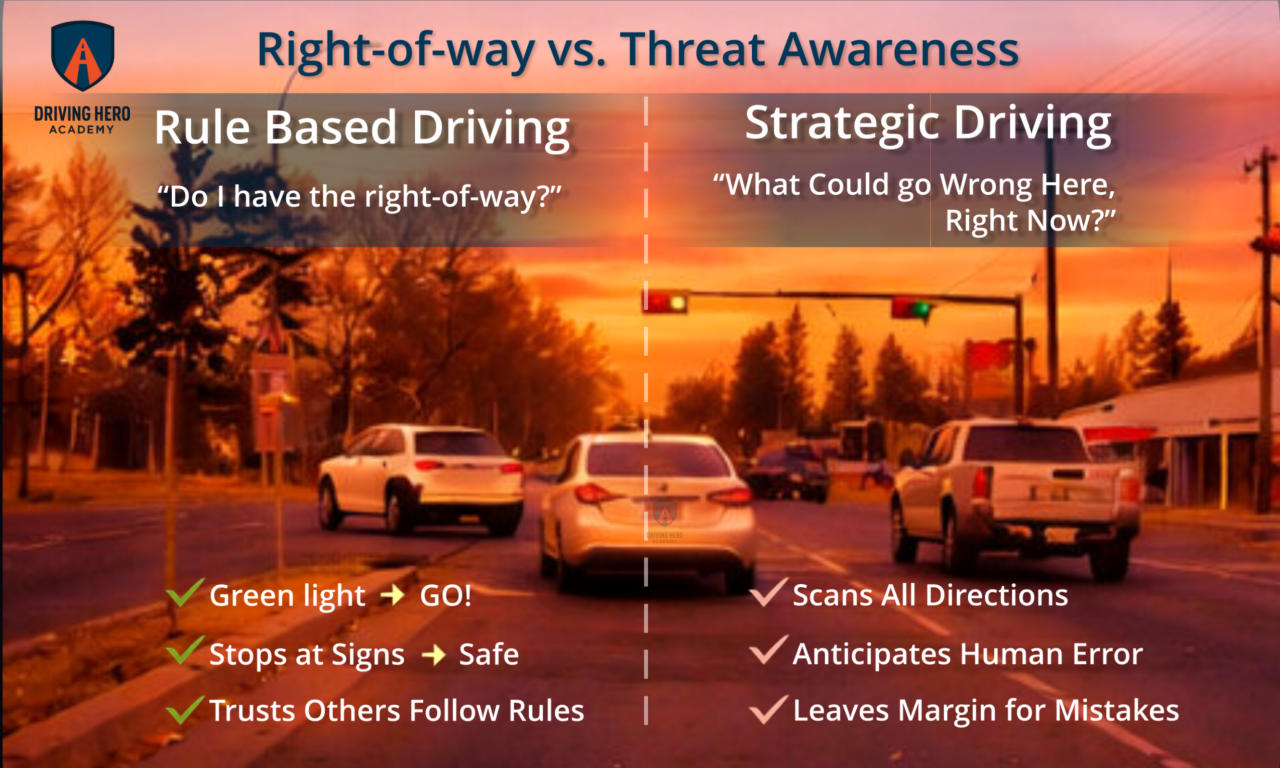



ACADEMY



DRIVING HERO















Privacy Policy | Terms

By La Velle Goodwin
Collision Prevention Specialist
Founder, Driving Hero Academy
Most serious intersection collisions
don’t occur because drivers break
the law - they occur because drivers
fail to see or correctly interpret
developing threats. Data from U.S.
and Canadian studies shows that
recognition errors, misjudgment of
gaps, and over-reliance on right-of-
way rules dominate collision
causation. This article explains why
ordinary drivers are vulnerable at
intersections and what strategic
driving practices can prevent
collisions.
Key Takeaways
• Roughly one-quarter of U.S. traffic fatalities and about half of all traffic injuries occur at intersections. Source: Federal Highway Administration – Intersection Safety • In the National Motor Vehicle Crash Causation Survey (NMVCCS), roughly 96% of intersection collision events had driver-attributed critical reasons, with recognition errors dominating. Source: NMVCCS – National Academies Press • Recognition errors - failing to see or misinterpreting hazards - are the largest driver-related cause of collisions. • Legal right-of-way is a coordination tool, not a safety guarantee. • Skilled drivers shift focus from “Do I have priority?” to “What could go wrong here right now?”The Trap Most Drivers
Fall Into
Most drivers are trained to follow rules and assume that compliance equates to safety. Over time, this leads to predictable vulnerabilities: • Late threat recognition • Narrow or incomplete scanning • Overcommitment to a chosen path of travel • No contingency planning if expectations are violated These drivers are not reckless. They are rule-focused, and rule-focus without threat awareness can blind drivers to developing hazards. Rules organize traffic but cannot substitute for real-time threat assessment.The Data Behind the
Problem
According to the Federal Highway Administration, intersections account for roughly one-quarter of traffic fatalities and about half of all injuries. In the NMVCCS crash causation survey, roughly 96% of intersection collision events were driver- attributed, meaning the last failure in the chain was linked to driver behavior - not legal fault or recklessness. Recognition errors - such as inattention, inadequate surveillance, or failing to detect another road user in time - were the largest single category. Canadian collision patterns at intersections show nearly identical trends, reinforcing the global relevance of these findings.Survival Requires a
Different Question
Rule-based driving asks: “Do I have the right of way?” Crash-avoidance driving asks: “What could go wrong here right now?” Skilled drivers evaluate: • Time-to-conflict rather than assumed priority • Speed differentials rather than signals alone • Line-of-sight limitations rather than ideal behaviours • Probability of human error rather than expected compliance This is the difference between compliance driving and strategic driving.Why Recognition Errors
Kill
Recognition errors account for roughly four out of ten crashes when categorized conservatively. When related subcategories are combined, recognition failures represent approximately half of all collision events. Decision errors - misjudging gaps, assuming another driver’s intent, or driving too fast for conditions - account for an additional one-third of intersection collisions. Together, this shows that the majority of serious collisions occur because drivers either fail to see the hazard or misjudge it, not because they break rules knowingly.The Older Driver
Paradox
NHTSA’s analysis shows older drivers are disproportionately involved in failure-to-yield collisions at stop signs and traffic signals, despite obeying all traffic controls. Common contributing factors: • Inadequate surveillance • Misjudgment of another vehicle’s speed or gap • Turning with an obstructed view These drivers rely on the rule rather than active threat assessment, exposing a systemic vulnerability.How Licensing and
Testing Reinforce the
Problem
Driver exams reward: • Rule adherence • Procedural correctness • Visible compliance They don’t test: • Early threat detection • Predictive scanning patterns • Risk calibration under uncertainty • Decision-making with incomplete information • Recognition of visual obstructions and human error As a result, drivers graduate thinking the system has prepared them for real-world driving, when data shows otherwise.Most Fatal Collisions
Don’t Involve “Bad
Drivers”
• They involve ordinary people on ordinary trips • Ordinary decisions made a fraction of a second too late Right-of-way failures consistently rank among the top contributing factors in fatal intersection collisions. Collisions occur not because rules were broken but because rules were trusted to provide protection.The Four Most
Dangerous
Assumptions at
Intersections
• “I have the green light, so it’s safe to go.” • “They’re slowing down; they see me.” • “The other driver will follow the rules.” • “I stopped, so I’m good to go.” Rule compliance cannot substitute for scanning, threat anticipation, and margin-building.A Better Way to Think
About Right-of-Way
Right-of-way is a coordination tool, not a shield. Legally, drivers must yield when conditions demand it - no one truly “has” the right-of-way until another driver yields through their actions. Skilled drivers: • Yield even when legally entitled • Delay when information is incomplete • Sacrifice priority for margin • Treat legality as secondary to survivability This is strategic driving.Cognitive Tunnelling:
Why Rules Can Blind
Drivers
Focusing exclusively on rule compliance narrows attention and excludes peripheral hazards. Drivers ask: “Did I stop fully?” instead of “What behaviour cannot be perceived from here?” Recognition failures are consistent because drivers aren’t trained to look for the threats that actually matter.The Goal Isn’t to Be
Right. It’s to Get Home
Safe driving is about managing risk where: • Humans make mistakes • Attention fails • Conditions change • Physics never negotiates Right-of-way organizes traffic; assuming it does anything more can be deadly.Frequently
Asked Questions
Q: What causes most serious intersection collisions? A: Recognition errors - failure to notice or misinterpret hazards - account for the majority of serious intersection collisions. Q: Does having the right-of- way make driving safe? A: No. Right-of-way is a coordination tool, not a safety guarantee. Blind reliance leads to collisions. Q: How common are driver- related causes in collisions? A: In NMVCCS, about 96% of intersection collision events were driver-attributed. Q: How can drivers prevent collisions at intersections? A: Focus on threat anticipation, strategic scanning, assuming others may not follow rules, and leaving margin for error.About the Author
La Velle Goodwin is a collision prevention specialist and the founder of Driving Hero Academy. She spent 13 years as a senior instructor at one of North America's most rigorous driver training organizations, completing a certification requiring substantially deeper training in crash causation, driver psychology, and instruction methodology than standard driving instructor licensing, with mandatory annual recertification. She delivered the organization's commercial driver training program, working directly with experienced professional drivers and observing first-hand the psychological resistance that makes behaviour change so difficult to achieve in that population. After leaving, she founded a corporate entertainment company whose programs were built entirely on competitive psychology - using the human drive to compete to move people toward behaviour they would never choose if simply told to. That work ran for over a decade across clients including oil and gas companies, Canada Post, and the Calgary Board of Education. The Crash Proof System brings those two bodies of expertise together: the science of how collisions develop, and the psychology of what actually makes people change.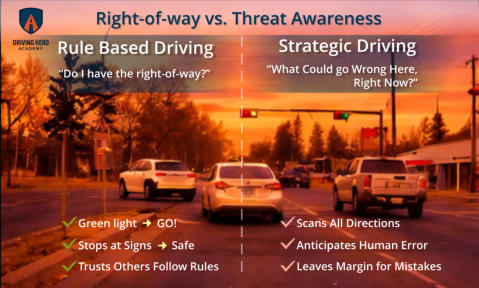

ACADEMY



DRIVING HERO





